Emotional Support Cats for Depression: What the Research Suggests
If you live with depression, you may already have noticed what many cat owners describe: the weight of a cat settling beside you on a hard morning, the low rhythm of a purr, a reason to get up and fill a food bowl. This article looks at an emotional support cat for depression the way a careful owner would. We cover what research suggests about cats and mental health, the physiology that may be involved, who should be cautious, and how a legitimate ESA letter works in your state. Nothing here is proven or promised, and nothing replaces care from a licensed clinician.
A note on this format
Ingredient deep-dives usually cover chemical composition, safety and sourcing. A cat is not an ingredient, so we apply the same structure to the questions that matter: what is happening biologically, what the evidence does and does not show, who should be careful, and how to find a good animal and a good clinician.
What research suggests about cats and mental health
The research on companion animals and mental health is real but mixed, and most of it is observational. That means it can show an association, such as pet owners reporting better mood, without showing that the animal caused it. Here is what the literature broadly offers.
- Systematic reviews. A 2018 systematic review in BMC Psychiatry (Brooks and colleagues) examined how companion animals relate to the everyday lives of people with long-term mental health conditions. It reported that many participants described their pets as an important source of support, while also noting that study quality varied and more rigorous work is needed.
- The human-cat bond. A 2019 study in Current Biology (Vitale, Behnke and Udell) found that many pet cats show secure attachment behavior toward their owners, similar in pattern to what is seen in dogs and infants. Research suggests the bond is genuine on the cat's side too, which may matter for why the relationship feels supportive.
- Cardiovascular observations. A 2009 analysis from the Minnesota Stroke Institute (Qureshi and colleagues) observed lower cardiovascular mortality among people who had owned cats. This is an association in one cohort, not a cure or a guarantee, and it concerns heart health rather than depression directly.
Honestly, studies also exist that find little or no difference in depression scores between pet owners and non-owners. Owners and non-owners differ in many ways, and a cat will not suit every person. Please treat everything above as observation rather than a claim of effect. Before you rely on any citation, we encourage you to read the original paper or ask your clinician about it.
The physiology that may be involved
There is no single active compound in a cat, but researchers have looked at several chemical messengers that may shift during human-animal contact. The table summarizes the commonly discussed ones, with the level of evidence stated plainly.
| Compound | Role in the body | What research suggests about cat contact |
|---|---|---|
| Oxytocin | Linked to bonding and social trust | Most human-animal oxytocin work involves dogs; evidence for cats is thinner and preliminary. |
| Cortisol | A stress-response hormone | Some small studies observe lower stress markers during calm animal contact; results vary. |
| Serotonin and dopamine | Involved in mood, motivation and reward | Often proposed as a mechanism, but direct evidence in cat owners is limited. |
Purring deserves a mention because owners ask about it constantly. Cat purrs typically fall in a low frequency range, and some researchers have speculated about calming effects, but the evidence for therapeutic benefit in humans is limited and contested. It is fair to say many people find the sound soothing; it is not fair to call it treatment.
Beyond chemistry: the practical ways a cat may help
Many people with depression describe the daily structure of a cat as at least as helpful as any biological explanation. Clinicians sometimes point to these everyday mechanisms:
- Routine. Feeding times, litter care and play create small, reliable tasks on days when motivation is low.
- Presence without demand. A cat offers company without requiring conversation, which some people find easier than human contact.
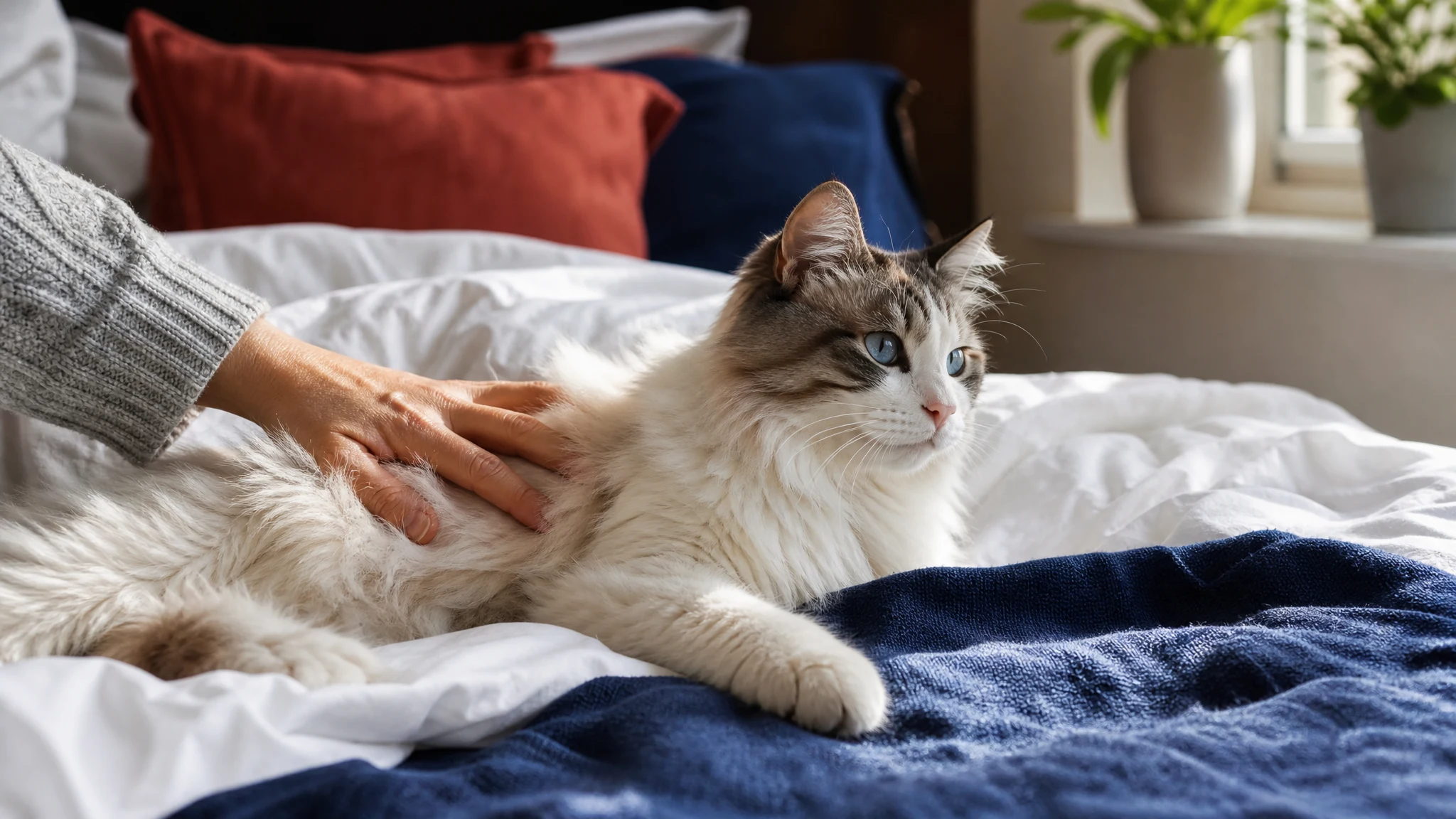
- Touch and warmth. Gentle petting offers a sensory anchor that many owners find grounding.
- Purpose. Being responsible for another living creature may counter the sense of uselessness that often accompanies depression.
Cats also suit many living situations. They are quiet, need no walks, and adapt well to apartments, which is one reason they are so common as emotional support animals.
Safety profile and contraindications
An honest deep-dive includes the downsides. A cat is a living animal with needs of its own, and the following points deserve real consideration.
- Allergies and asthma. Cat allergens (notably the protein Fel d 1) can trigger symptoms in sensitive people. Ask your physician before bringing a cat home if you have asthma or known allergies.
- Pregnancy and immune suppression. Cat feces can carry Toxoplasma gondii. Pregnant people and those with weakened immune systems should ask their doctor about litter-box precautions.
- Scratches and bites. These can occasionally transmit infections such as Bartonella (cat-scratch disease). Wash wounds promptly and seek care if they worsen.
- Cost and capacity. Veterinary care, food and litter are ongoing expenses. During a severe depressive episode, caring for an animal can feel overwhelming, so think through backup support before you commit.
- Grief risk. Cats can live fifteen to twenty years. Loss of an animal can be painful for anyone, and especially so for a person already managing depression.
- Not a replacement for treatment. An ESA is not therapy or medication. If you are in crisis or having thoughts of harming yourself, contact a licensed professional or call or text 988, the Suicide and Crisis Lifeline, in the United States.
Sourcing and quality indicators
Choosing the cat
There is no required breed, age or pedigree. What research and shelter staff both suggest matters most is temperament and fit. Look for:
- A cat that is calm and comfortable being handled, often an adult whose personality is already established.
- A recent veterinary exam, vaccinations and a clear health history.
- A shelter or rescue willing to discuss the animal's behavior honestly and offer a trial or meet-and-greet period.
- A match between the cat's energy and your own household, since a quiet senior cat and a playful kitten offer very different experiences.
Choosing the clinician
Quality here carries more weight than any other choice you make. A valid ESA letter comes only from a licensed mental health professional (LMHP) licensed in the same state as the client, such as an LCSW, LMHC, LMFT, psychologist or psychiatrist, or a licensed primary-care provider where state law permits. Indicators of a legitimate process include:
- A real evaluation by a licensed clinician who determines for themselves whether an ESA is therapeutically appropriate. Approval is never automatic.
- A license you can verify through your state board.
- No promises of guaranteed approval, instant letters or same-day results.
- Clear acknowledgment of your state's rules, described below.
Be wary of fly-by-night sites that sell a certificate or registry number for a few dollars and imply it carries legal weight. It does not.
How ESA letters and housing protection work
Under the federal Fair Housing Act, a person with a disability-related need may request a reasonable accommodation to keep an assistance animal, including an emotional support animal, in housing that otherwise restricts pets. HUD's notice FHEO-2020-01, titled "Assessing a Person's Request to Have an Animal as a Reasonable Accommodation Under the Fair Housing Act," is the federal guidance on how housing providers should evaluate those requests. Documentation from a licensed health care professional who knows the person is a central part of that process. If you are wondering whether your own cat could fit, our guide on whether a cat can be an emotional support animal and who qualifies walks through the basics.
Several points are worth stating plainly:
- A letter from a licensed clinician is the document that matters for housing. No clinician can promise a landlord will agree, and housing providers may ask for reliable documentation within the limits HUD describes.
- ESAs are not service animals and do not have public-access rights to shops or restaurants.
- Air travel: since the Department of Transportation's 2021 rule change, emotional support animals are no longer covered by the Air Carrier Access Act. Airlines treat them as ordinary pets, so check airline pet policies directly.
State rules that affect timing and eligibility
ESA rules apply in every U.S. state through federal law, but several states add requirements about the clinician relationship. These are the ones to know:
- California (AB-468), Montana (HB-703), Arkansas, Iowa and Louisiana: state law requires a minimum 30-day established therapeutic relationship between you and the clinician before an ESA letter can be issued. This is a feature of those laws, designed to ensure a genuine clinical assessment, and it means no honest provider can promise faster turnaround in those states.
- Florida (Fla. Stat. 760.27): the clinician must be licensed in Florida or have an established prior in-person relationship with the client. Online-only providers licensed elsewhere cannot issue a valid Florida ESA letter.
- All other states: the federal framework applies, and your clinician must be licensed in your state. Local and state fair-housing rules can add detail, so review your own state's requirements.
Registration is optional, and it is not the letter
Some owners also choose an optional registration, which on this site includes a lost-pet recovery database, an ID card and certificate, and a discount on the ESA letter. To be clear, registration is not a legal requirement, and housing rights under the Fair Housing Act come only from a letter written by a licensed mental health professional. A registration number, ID card or certificate does not replace that letter, and a landlord is not obliged to accept one in its place. The practical benefit to weigh is the lost-pet recovery database: a cat that slips out of a window can be matched to its owner faster. If that appeals to you, here is how to register your cat as an emotional support animal.
Questions to bring to your clinician
- Could an emotional support cat be therapeutically appropriate alongside my current care?
- Are there health considerations, such as allergies or pregnancy, I should discuss with my doctor first?
- What does my state require before a letter can be issued, and how long does that take?
- How should I build a support plan for days when caring for my cat feels hard?
The bottom line
Research suggests that cats may offer comfort, routine and companionship to some people living with depression, and many owners say their cat is a steady part of getting through difficult days. The science is still developing, the benefits are not guaranteed, and a cat is one piece of care rather than the whole of it. If you think an emotional support cat may help, the best next step is a conversation with a licensed clinician in your state who can evaluate your situation individually.
Disclaimer: This article is informational only and is not medical, mental-health or legal advice. Please consult a clinician licensed in your state about your own mental health and whether an ESA is appropriate for you. For landlord disputes, consult an attorney licensed in your state, or contact your local legal aid office for help with Fair Housing Act enforcement. Citations are summarized for general orientation; please confirm details against the original sources.
Ready to start your ESA letter?
Licensed clinician review. Compliant with state law.
Get My ESA Cat Letter