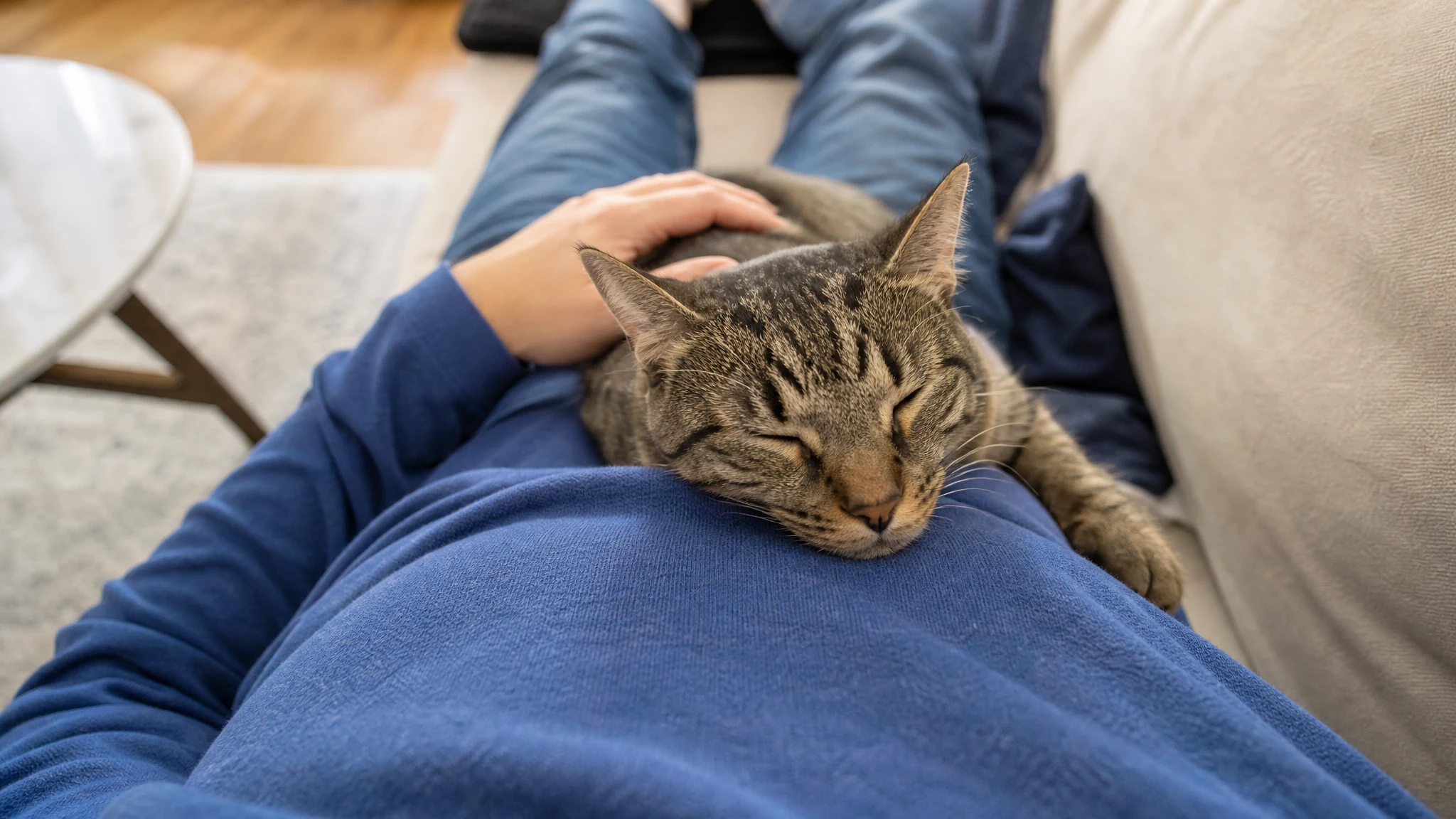
Cats and Mental Health: What the Research Actually Shows
Anyone who has felt their shoulders drop when a cat settles into their lap already has a hunch about cats and mental health. The research is more careful than the hunch. It is encouraging in places, mixed in others, and nowhere near a promise. This deep dive takes the same approach we would take with any ingredient: what is actually in the interaction (the neurochemistry), what studies have observed, who should be cautious, and how to judge quality, whether you are choosing a cat or a clinician. A note on format: a cat has no ingredient list, so the 'compounds' section below looks at the body's own chemistry during human-cat contact.
This article is informational only. It is not medical, mental-health or legal advice. A licensed mental health professional in your state can speak to your situation, and a licensed attorney in your state can help with any housing dispute.

Why 'Cat Therapy' Is a Loose Term
Cat therapy and cat therapy for humans are everyday phrases, not clinical categories. They can mean three different things:
- Everyday companionship: living with a cat and the routines that come with it.
- Animal-assisted interventions: structured sessions in which a trained professional includes an animal in treatment, sometimes a cat in a care facility.
- An emotional support animal (ESA): a companion animal that a licensed clinician has determined may be therapeutically appropriate for a particular person.
Studies rarely separate these, and that is the first reason to read headlines with care. When someone asks whether cats are good for mental health, the honest answer is that many people report benefits and some studies observe them, but results depend on the person, the cat and the circumstances.
The 'Compounds': Neurochemistry of Human-Cat Contact
Researchers who study the human-animal bond usually look at a handful of biological markers. The table summarizes what has been examined and how firm the evidence is. Read the right-hand column as a caution label.
| Marker | What it is | What research suggests | Strength of evidence |
|---|---|---|---|
| Oxytocin | A hormone and neuropeptide linked to bonding and social comfort | Some studies of pet owners have observed oxytocin changes during gentle contact; most of the best-known work involves dogs, with fewer cat-specific studies | Emerging; small samples |
| Cortisol | A stress hormone that follows a daily rhythm | Some small studies have observed lower stress markers or lower reported stress after calm animal contact; others find no difference | Mixed |
| Heart rate and blood pressure | Physiological arousal indicators | Observational work has associated pet ownership with favorable cardiovascular markers, though pet owners may differ from non-owners in other ways | Associational, not causal |
| Purring vibration | Low-frequency sound, commonly described in the range of roughly 25 to 150 Hz | The acoustics are well described; claims about therapeutic effects on people are largely hypotheses and have not been established | Speculative for humans |
One way to think about the oxytocin findings: contact with a trusted animal appears to engage some of the same social-bonding systems involved in human attachment. That is an interesting observation. It is not evidence that a cat will treat any condition.
What the Research Suggests
Attachment is real, and cats are not as aloof as their reputation
A 2019 study by Vitale, Behnke and Hynes in Current Biology adapted an infant-caregiver attachment test for cats. Many of the cats appeared to use their person as a source of security, which suggests the bond is not one-sided. That matters for mental health research because a relationship that both parties experience as secure is likelier to be the one people describe as comforting.
Companionship and loneliness
A systematic review by Brooks and colleagues (2018, BMC Psychiatry) examined how companion animals figure in the lives of people with long-term mental health problems. Participants frequently described pets as a source of companionship, routine and a sense of being needed, and many ranked them among their most important supports. The review also noted limits in study quality. Other research on older adults who live alone (for example, Stanley and colleagues, 2014, Aging & Mental Health) found that pet ownership was associated with less loneliness, with the authors noting the design could not prove cause and effect.
Cardiovascular and wellbeing associations
A cohort analysis by Qureshi and colleagues (2009) reported that cat owners had a lower rate of cardiovascular death than people who had never owned a cat. Association is not causation: owners may differ in income, health habits or temperament. Surveys on general wellbeing, such as Bao and Schreer (2016, Anthrozoös), also report positive associations, though they depend on self-report.
The honest counterweight
Herzog's well-known 2011 review in Current Directions in Psychological Science found that studies of pets and psychological health conflict, with some showing benefits, some none, and a few showing the opposite. This is why responsible sources avoid saying cats 'cure' anything. A cat that is a poor fit, an unaffordable vet bill, or grief when a pet dies can all add stress. Research suggests the quality of the bond matters more than ownership alone.
Where an Emotional Support Cat Fits In
Living with a cat and having an emotional support animal overlap but are not the same. An ESA designation comes from an individual evaluation by a licensed mental health professional (LMHP) licensed in the same state as the client, such as a licensed clinical social worker, licensed mental health counselor, marriage and family therapist, psychologist, psychiatrist, or, where state law permits, a licensed primary-care provider. That clinician decides whether an ESA may be therapeutically appropriate for you. Many people with anxiety, depression or loneliness find a companion animal helpful, but the clinician, not an article and not a website, makes that determination.
If you want the fuller picture, our guide on whether a cat can be an emotional support animal and who qualifies covers the eligibility questions in detail. If you have already talked with a clinician and want to understand the steps, see how to register your cat as an emotional support animal.
What the law actually provides
Housing protection for emotional support animals comes from the federal Fair Housing Act. HUD's notice FHEO-2020-01, 'Assessing a Person's Request to Have an Animal as a Reasonable Accommodation Under the Fair Housing Act,' is the federal guidance housing providers are expected to follow when evaluating a request. The documentation that supports a request is a letter from a licensed mental health professional. Landlords may still have legitimate grounds to decline in specific circumstances described in that guidance, so a letter is not an automatic guarantee in every situation.
A few points apply to every state:
- Registration, ID cards and certificates are not legal requirements. Housing rights under the Fair Housing Act come only from a letter written by a licensed mental health professional. A registry number or ID card does not replace that letter, and no landlord is required to accept one in its place. Our optional registration service (lifetime registration, a lost-pet recovery database, an ID card and certificate, and a discount on the ESA letter) is worth considering mainly for lost-pet recovery: a database entry can help reunite you with a cat that slips out of the door. It confers no legal status.
- Air travel: since the Department of Transportation's 2021 revision to its Air Carrier Access Act rules, airlines treat emotional support animals as ordinary pets. An ESA letter does not carry air-travel rights.
- Be wary of cheap certificates. Sites that sell a certificate for a few dollars with no clinician involved are not providing a valid letter.
State rules that differ
The federal framework is the same everywhere, but several states add requirements about the clinician relationship. These are the ones to know:
- California (AB-468), Montana (HB-703), Arkansas, Iowa and Louisiana: state law requires an established therapeutic relationship of at least 30 days between you and the clinician before an ESA letter can be issued. A compliant process takes at least that long, and that is the point: it reflects how those states want these evaluations done.
- Florida: Florida Statute 760.27 requires the clinician to be licensed in Florida or to have an established prior in-person relationship with the client. Online-only providers licensed elsewhere cannot issue a valid Florida ESA letter.
- All other states: the clinician must be licensed in the state where you live, and individual rules on housing documentation can vary, so check your state's current requirements.
Laws change, so confirm the current rules for your state with your clinician. For a dispute with a landlord or association, consult an attorney licensed in your state; your local legal aid office can also help with Fair Housing Act enforcement questions.
Safety Profile and Contraindications
Most of the mental health conversation skips this section, which is a mistake. A cat is a living animal with its own health needs, and the following are worth weighing:
- Allergies and asthma: the major cat allergen, Fel d 1, is found in saliva and skin secretions and travels on dander. If you have respiratory conditions, talk with a physician before adopting. Time spent with a cat before committing is a practical test.
- Zoonotic infections: cat scratch disease (Bartonella henselae), ringworm and toxoplasmosis are the usual concerns. Routine veterinary care, flea control and careful litter handling reduce the risk considerably. Toxoplasmosis is of particular concern during pregnancy and for people with weakened immune systems; those readers should ask their physician before handling litter. Occasional media stories link Toxoplasma to psychiatric conditions, but the evidence is inconclusive and should not drive decisions.
- Bites and scratches: wash wounds promptly and see a clinician if a wound becomes red, swollen or painful.
- Grief and caregiving burden: a cat can live 15 years or more. Illness and loss are a real emotional cost, and people already facing a difficult period should plan realistically for time, money and attachment.
- Not a replacement for care: research on companion animals describes them as a supplement to treatment. If you are in crisis, contact a licensed professional or call or text 988 in the United States.
Sourcing and Quality Indicators
For a cat, quality means a good match of temperament, health and your living situation, not a pedigree.
- Shelters and rescues: adult cats with known personalities are often easier to match to a calm household than kittens, and many rescues provide veterinary records, vaccinations and a trial period.
- Health records: ask for vaccination history, spay or neuter status and any known conditions. Schedule a vet visit in the first weeks.
- Temperament: look for a cat that approaches people, tolerates handling and recovers calmly from noise. Shy cats can thrive too, but they may not suit someone seeking a lap companion.
- Responsible breeders, if you go that route: they allow you to visit, show health screening and do not rush the sale.
Quality also applies to the clinician and the letter. Signs of a legitimate process include:
- A real evaluation by a licensed mental health professional, licensed in your state, who speaks with you individually.
- Honest language about uncertainty: no promise of approval, because a clinician decides case by case.
- Clear statements that registration and ID cards are optional and not a legal requirement.
- Compliance with your state's clinician-relationship rules, including the 30-day requirement where it applies.
Red flags include instant letters, guaranteed approval, certificates with no clinician and claims that a registration number will satisfy a landlord.
Putting It Together
So, are cats good for mental health? Research suggests that many people experience comfort, routine and companionship from living with a cat, and some studies observe changes in stress-related markers, but the evidence is mixed, often associational and rarely cat-specific. Cat therapy works best when understood as one possible support among others, with a qualified clinician guiding the bigger picture. If you think an emotional support cat could help you, the next step is a conversation with a licensed mental health professional in your state, and a look at your state's specific rules before you begin.
Disclaimer: This article is informational content and is not medical, mental-health or legal advice. It does not diagnose any condition or recommend any treatment. Consult a licensed mental health professional in your state about whether an emotional support animal is appropriate for you, and consult an attorney licensed in your state, or your local legal aid office, for any landlord or housing dispute. Review your state's current ESA rules before acting.
Ready to start your ESA letter?
Licensed clinician review. Compliant with state law.
Get My ESA Cat Letter