Microchip, ID Tag or Recovery Database: Which Actually Gets a Lost Cat Home
Every cat owner eventually has the same cold-stomach moment: the door was open for three seconds, the cat is gone, and you are standing on the porch shaking a bag of treats. What happens over the next several days depends less on luck than on the identification you set up beforehand. Yet owners often treat a microchip, an ID tag and a pet recovery database as interchangeable, when they are really three different links in one chain. This comparison explains what each one does, where each one fails, and how to combine them, whether you live in a studio apartment or a farmhouse, in any U.S. state.
The short answer
No single option wins on its own. A microchip is the permanent identifier, a cat ID tag is the fastest visible clue, and a recovery database is what turns a chip number into a phone call to you. A microchip that is implanted but never registered, or registered once and never updated, is little more than a number nobody can connect to a person. If you have to choose a priority, put the microchip in and make sure its registration is current, then add a breakaway collar with a tag as a second layer.
How a lost cat actually gets home
It helps to picture the sequence. Someone finds your cat, perhaps a neighbor, a shelter volunteer or a veterinary technician. They do one of two things: they look at the cat for a collar and tag, or they take the cat to a shelter or clinic that scans for a chip. If a tag is present, they can call you directly, often within minutes. If there is a chip, the scanner shows a number, and that number must be looked up in a registry that holds your name and phone number. If any link is missing (no tag, no chip, or no current contact information behind the chip), the cat becomes a stray in the system, and getting home takes much longer.
Option one: the microchip
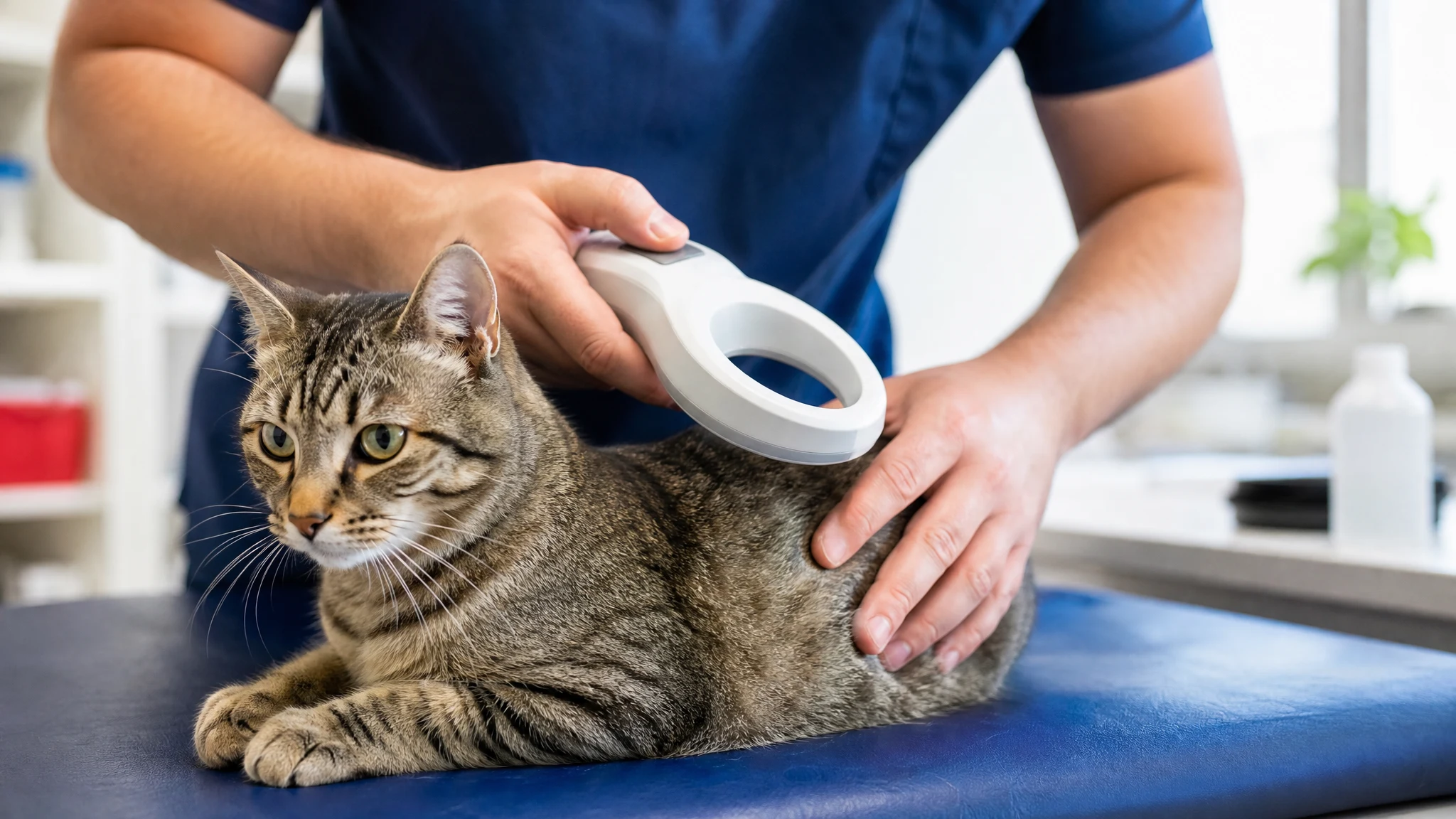
A pet microchip is a small transponder, roughly the size of a grain of rice, implanted under the skin between the shoulder blades by a veterinarian or shelter. It has no battery and no GPS. It does not track your cat; it simply transmits a number when a handheld scanner passes over it. Because it sits under the skin, it cannot slip off, be chewed through or fade.
Pros
- Permanent. It cannot be lost the way a collar can, which matters for indoor cats who bolt outside without warning.
- Widely scanned. Animal shelters and veterinary clinics routinely scan incoming animals.
- One-time procedure. Most owners find it a quick visit with minimal discomfort, though you should ask your veterinarian about your own cat.
Cons
- Invisible. A neighbor who finds your cat cannot see a chip, so it only helps once the cat reaches someone with a scanner.
- Useless without registration. The chip stores a number, not your address. Cat microchip registration is a separate step, and many chips are never registered at all.
- Information goes stale. If you move or change phone numbers and forget to update the record, the chip points to a dead end.
Option two: the cat ID tag
A cat ID tag is a small engraved or QR-coded tag on a collar. It is the oldest form of pet identification and still the only one that works for a person with no equipment at all.
Pros
- Instant and visible. A finder can read your phone number and call you from the sidewalk.
- Inexpensive and easy to update. If your number changes, you replace the tag.
- Signals "this cat has a home." A collared cat is less likely to be mistaken for a stray.
Cons
- Collars come off. Safe cat collars are designed to break away if snagged, which also means the collar can vanish during exactly the adventure that gets a cat lost.
- Tags wear down. Engraving fades, rings open, and tiny type is hard to read.
- Some cats resist collars. A cat that fights a collar may be better served by a chip as the primary identifier.
Option three: the pet recovery database
A pet recovery database is the registry layer that links an identifier to a human being. When a shelter scans a chip, staff look up the number in a registry, or use a lookup tool that searches several participating registries, to find the owner's contact details. A good lost pet recovery database also does more than store a phone number: it can alert you when your record is looked up, let you flag your cat as missing, and give you a place to keep a current photo and description.
Pros
- Makes the microchip functional. This is the step that connects the number to you.
- Easy to keep current. You can usually update an address or phone number online in minutes.
- Can add recovery tools. Depending on the provider, features may include missing-pet alerts, backup contacts and a record that follows the cat if you move.
Cons
- Only as good as your record. An outdated entry is the single most common reason a chipped cat is not reunited quickly.
- Registries are fragmented. Different chip manufacturers work with different registries, so it is worth confirming which registry holds your cat's number and whether lookup tools can find it.
- Some charge fees. Costs and features vary, so read what is included before you pay.
Side-by-side comparison
| Attribute | Microchip | Cat ID tag | Recovery database |
|---|---|---|---|
| What it is | Implanted transponder with a unique number | Engraved or QR tag on a collar | Online registry linking an ID number to your contact details |
| Visible to a finder | No | Yes | No |
| Needs special equipment | Yes, a scanner | No | No, but someone must look up the record |
| Can fall off or be removed | Extremely unlikely | Yes | Not applicable |
| Works on its own | Only if registered with current details | Yes, while the tag is on the cat | No, it needs an identifier to match |
| Needs periodic updating | Not the chip, but its registration does | When your phone number changes | Whenever you move or change contacts |
| Main weakness | Unregistered or outdated records | Collars come off | Only useful alongside an ID |
Best for: recommendations by situation
- Strictly indoor cats: Microchip plus a current database record. Indoor cats most often escape through doors and windows, may not be wearing a collar at that moment, and are frightened and hard to recognize when found. A tag is a worthwhile extra if your cat tolerates a breakaway collar.
- Indoor-outdoor cats: All three. Outdoor cats are the most likely to be picked up by a well-meaning neighbor, so a visible tag speeds things up, while the chip covers the collar that snagged on a fence.
- Cats that refuse collars: Microchip and database first. Do not force a collar; a cat that panics in one may be at greater risk.
- Renters and frequent movers: Prioritize a database you can update from your phone. A move is the moment records most often go stale.
- Travelers and multi-cat households: A database that stores a photo and description for each cat, plus a backup contact who is not in your own home, so a call is answered even if you are away.
- Adopted or rescued cats: Ask whether the cat is already chipped, then scan and confirm the registration is in your name. Previous owners' details sometimes remain on file.
A note on registration and emotional support cats
Because this site also serves people who share their homes with an emotional support cat, a clarification is worthwhile. Our optional registration service includes lifetime registration, a lost-pet recovery database, an ID card and certificate, and a discount on an ESA letter. For most owners, the real value is the first item: a record that can help reunite you with your cat.
Registration is not a legal requirement. Housing protections under the federal Fair Housing Act come only from a letter written by a licensed mental health professional, as described in HUD's FHEO-2020-01 notice, Assessing a Person's Request to Have an Animal as a Reasonable Accommodation Under the Fair Housing Act. A registration number, ID card or certificate does not grant rights, and a landlord is not required to accept one in place of that letter. If you are exploring the letter itself, our guide on how to register your cat as an emotional support animal walks through the process and what a legitimate evaluation involves.
State rules for the letter differ, and a clinician must be licensed in your state. For example, California, Montana, Arkansas, Iowa and Louisiana require an established clinician relationship of at least 30 days before a letter can be issued, and Florida Statute 760.27 requires a Florida-licensed clinician or an established prior in-person relationship. Please also note that since 2021 the Department of Transportation no longer includes emotional support animals under the Air Carrier Access Act, so airlines generally treat them as ordinary pets.
The verdict
If you remember one thing, make it this: identification only brings a cat home when someone can connect it to you. The microchip is the strongest permanent foundation, the tag is the fastest shortcut for an ordinary finder, and the pet recovery database is what makes both of them useful in practice. Ranked by how often each one is the difference-maker for a cat that is never seen wearing a collar again:
- Microchip with a current database record (treat these as one item, since neither works well without the other).
- Breakaway collar with a legible cat ID tag as the visible second layer.
- A recent photo and a backup contact kept on file, so a finder or shelter can confirm the match.
Set a reminder once a year, and whenever you move or change your phone number, to check that your cat microchip registration is current. It takes a few minutes and is the cheapest insurance in cat ownership. If you want a single place that combines lost-pet recovery with optional ESA services, our registration service is designed to do exactly that, but it is a convenience, not a requirement.
Disclaimer
This article is informational content only. It is not medical, mental-health or legal advice. Whether an emotional support animal is therapeutically appropriate is determined by a licensed mental health professional (such as an LCSW, LMHC, LMFT, psychologist or psychiatrist) who is licensed in your state, so please consult a qualified clinician licensed in your state and review your state's specific rules. For landlord or housing disputes, consult an attorney licensed in your state, or contact your local legal aid office for help with Fair Housing Act enforcement.
Ready to start your ESA letter?
Licensed clinician review. Compliant with state law.
Get My ESA Cat Letter