Ragdoll Cats as Emotional Support Animals: A Science-Focused Deep Dive
If you are weighing emotional support cat breeds, the Ragdoll tends to appear near the top of every list, and the reputation is not entirely undeserved. This deep dive looks at what is actually known about Ragdoll cat temperament, the biology behind the human-cat bond, the genetic health issues a responsible owner should understand, and how to source a healthy cat. It also sets out what the law does and does not require. Where the research is thin or contested, we say so plainly.
This article is informational only. It is not medical, mental-health or legal advice. A licensed mental health professional (LMHP) in your state decides whether an emotional support animal is therapeutically appropriate for you, and a licensed attorney in your state can advise on any housing dispute.
First, an Honest Note on the "Ingredient" Framing
A breed is not a compound, so there is no chemical formula to print here. What we can examine are the biological and behavioral "ingredients" that make a cat suitable for emotional support: temperament, the physiology of the bond, coat and allergen profile, and heritable health risks. We cover each below.
The Breed Profile: What a Ragdoll Is
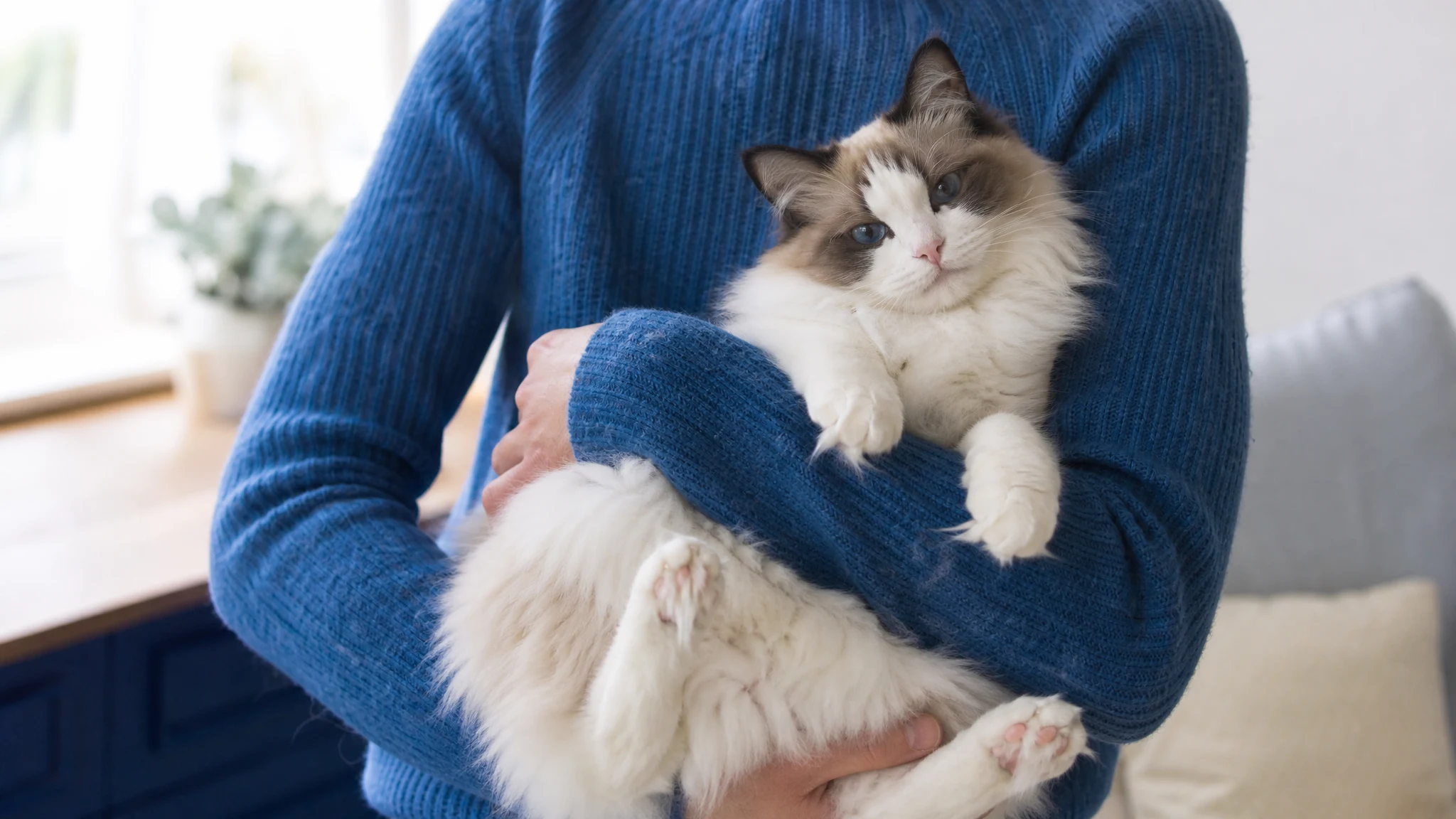
The Ragdoll is a large, semi-longhaired breed developed in California in the 1960s. Adult males commonly reach 15 to 20 pounds, and females are somewhat smaller. The breed matures slowly, often not reaching full size and settled adult behavior until three to four years of age. The coat comes in colorpoint, mitted and bicolor patterns, and the eyes are blue. These physical traits are well documented by the major cat registries.
One popular claim deserves correction. You will sometimes read that Ragdolls are insensitive to pain or "go limp" because of a genetic quirk. We are not aware of credible peer-reviewed evidence for pain insensitivity in the breed, and a cat that appears tolerant of handling may still be in pain. Treat any such claim as folklore, and never assume a Ragdoll will not feel discomfort.
Ragdoll Cat Temperament: What the Evidence Supports
Breed descriptions are built mostly on breeder and owner reports, not controlled trials, so they are best read as tendencies rather than guarantees. Ragdoll cat temperament is commonly described as docile, people-oriented, and tolerant of handling, and many owners report cats that follow them from room to room and greet them at the door.
Research on feline behavior offers some context. Studies of cat personality, including large owner-reported surveys, suggest that traits such as sociability and tolerance vary meaningfully between breeds, but also vary widely within each breed. A 2019 study published in Current Biology (Vitale and colleagues) found that a majority of cats tested showed secure attachment to their caregivers, a pattern comparable to that seen in infants and dogs. That finding applies to cats in general, not to Ragdolls specifically, and it is a useful reminder that individual history, early handling and environment matter at least as much as pedigree.
In practical terms, a Ragdoll that was handled gently as a kitten, raised in a household and well socialized is more likely to be the calm lap cat the breed is known for. An under-socialized Ragdoll can still be shy or reactive.
The Biology of the Bond: Research Observations
People who find an emotional support cat helpful often describe feeling calmer during quiet contact. Several lines of research may help explain why, though none of them is proof that any animal treats a condition.
Oxytocin and social contact
Oxytocin is a hormone associated with bonding and stress regulation. Research on mutual gazing and petting between people and dogs has reported increases in oxytocin in both species, and a smaller body of work suggests similar interactions with cats. The cat evidence is considerably thinner than the dog evidence, and results are not uniform across studies. Research suggests the effect is plausible, not that it is guaranteed for any particular person or cat.
Purring
A cat's purr falls roughly in the 25 to 150 Hz range. Some researchers have speculated that vibrations in this range could be associated with tissue and bone healing in cats themselves, and some owners find the sound soothing. These ideas are hypotheses. We are not aware of conclusive human clinical evidence that listening to a cat purr treats any condition, so we describe it as a comforting sound many people enjoy, nothing more.
Stress and routine
Observational studies on pet ownership have reported associations with lower self-reported loneliness and with more structured daily routines, such as feeding and play. Association is not causation: people who choose to keep pets may differ from those who do not. A licensed clinician will weigh these factors alongside your history, which is why the evaluation matters more than the breed.
Safety Profile and Contraindications
This is where a science-focused look at the Ragdoll matters most for a prospective owner.
Heritable heart disease
Hypertrophic cardiomyopathy (HCM), a thickening of the heart muscle, is the most common heart disease in cats. In Ragdolls, a specific mutation in the MYBPC3 gene (often called R820W) was identified in published veterinary genetics research by Meurs and colleagues in 2007, and a genetic test is available. A positive result in a given cat does not guarantee disease, and a negative result does not eliminate every cause of heart disease, but breeders who test and screen breeding cats are reducing risk. Ask any breeder to show you test results for both parents.
Other health considerations
- Urinary issues: Some veterinary sources note that Ragdolls may be predisposed to bladder stones. Fresh water access and regular veterinary checkups help.
- Weight: A large, laid-back cat can become overweight, which compounds joint and heart strain. Measured meals and play matter.
- Coat care: The semi-long coat mats less than some breeds but still needs brushing several times a week. Matting can be painful for the cat.
- Indoor living: A trusting temperament makes outdoor roaming riskier. Most Ragdoll breeders and veterinarians recommend indoor-only living.
Allergies
No cat breed is truly hypoallergenic. The main cat allergen, Fel d 1, is produced by all cats to varying degrees, and individual cats within a breed differ more than breeds differ from each other. If you or anyone in your home has allergies or asthma, spend extended time with the specific cat before committing, and speak with your physician.
Who may want to think twice
Ragdolls are people-dependent. A cat that thrives on companionship may struggle in a household where it is alone for very long hours. If your schedule keeps you away most of the day, a pair of cats or a more independent adult cat may suit better. Your clinician can help you think through whether an animal's care demands fit your current circumstances.
Sourcing and Quality Indicators
You do not need a purebred, or any particular breed, for a cat to be an emotional support animal. The Fair Housing Act framework applies to the individual animal and the individual person, not to a pedigree. If you do want a Ragdoll, these indicators separate careful sources from careless ones:
- Health testing: Documented HCM genetic testing on both parents, plus a written veterinary health guarantee.
- Registry paperwork: Registration with a recognized cat fancier association, which documents lineage. Remember this documents the cat's pedigree, not any legal status.
- Home raising: Kittens raised underfoot in a household, not in a cage or shipped sight unseen. Be wary of anyone who will not let you visit, video call or meet the parents.
- Age at placement: Reputable breeders typically keep kittens until about 12 to 16 weeks for vaccines and socialization.
- No pressure tactics: A good breeder asks you questions and may keep a waiting list.
Do not overlook adoption. Breed-specific Ragdoll rescues exist, and adult cats come with known personalities, which can be an advantage when you are looking for a specific temperament.
The Legal Reality: What Actually Makes a Cat an ESA
Under federal housing law, a person with a disability-related need may request a reasonable accommodation for an assistance animal. HUD's notice FHEO-2020-01, "Assessing a Person's Request to Have an Animal as a Reasonable Accommodation Under the Fair Housing Act," is the federal guidance on how housing providers evaluate such requests. In general, the documentation that supports a request comes from a licensed mental health professional who knows the person and is licensed in the person's state. A breed has nothing to do with it, so a Ragdoll receives no more or less protection than any other cat.
A word on registration: some services, including this site, offer an optional registration that can include a lost-pet recovery database, an ID card and a certificate. None of that is a legal requirement, and none of it creates housing rights. Those rights come only from a letter written by a licensed clinician. The most practical benefit of registering is lost-pet recovery, since a large, friendly cat who trusts strangers is exactly the kind of cat that gets picked up and carried off. Registration should never be presented to a landlord in place of a letter. You can read more in our guide on how to register your cat as an emotional support animal.
State rules that vary
- California, Montana, Arkansas, Iowa and Louisiana: state law requires an established client-clinician relationship of at least 30 days before an ESA letter can be issued. A compliant provider honors this timeline, which is a feature of a legitimate evaluation rather than a delay.
- Florida: Florida Statute 760.27 requires the clinician to be licensed in Florida or to have an established prior in-person relationship with the client. An online-only provider licensed elsewhere cannot issue a valid Florida letter.
- Every other state: the clinician should be licensed in your state, and you should review your state's current rules, since they change.
Be cautious of any service that promises guaranteed approval, an instant letter, or a certificate sold for a few dollars with no clinical conversation. A legitimate clinician evaluates each person individually, and approval is never automatic. A letter from a service without a real evaluation may be rejected, and it can create trouble for you.
Also note that emotional support animals no longer have air-travel protections. The Department of Transportation removed them from the Air Carrier Access Act rules in 2021, and airlines now treat ESAs as ordinary pets, subject to their pet policies and fees.
Is a Ragdoll Right for You?
The research summarized here suggests that the human-cat bond may offer comfort to many people, and the Ragdoll's reputation for gentleness makes it a popular choice among emotional support cat breeds. But the most important variables are the individual cat's health and socialization, and whether the animal's needs fit your life. A thoughtfully chosen mixed-breed shelter cat can be every bit as soothing as a pedigreed Ragdoll.
If you are considering an ESA, the next step is a conversation with a licensed mental health professional in your state, who will determine whether an emotional support animal is therapeutically appropriate for you. If you run into trouble with a landlord, contact a licensed attorney in your state or your local legal aid office, who can help with Fair Housing Act enforcement.
Disclaimer
This article is for general informational purposes and is not medical, mental-health or legal advice. It does not diagnose any condition or suggest that you need an emotional support animal. Research cited is described as observation and is not proof of treatment effect. Laws and agency guidance change, so consult a clinician licensed in your state, review your state's current requirements, and consult a licensed attorney in your state for any landlord dispute.
Ready to start your ESA letter?
Licensed clinician review. Compliant with state law.
Get My ESA Cat Letter